From a thumbprint in wet clay to a porcelain cup that rings like a bell, ceramics record everyday life with unusual durability. Broken pots, fired bricks, and glazed tiles often outlast wood, cloth, and even written pages.
This article surveys the history of ceramics from the earliest fired clay objects to industrial production, highlighting how changes in heat, materials, and trade reshaped what people could make—and what those objects meant.
Origins: Clay, Fire, and the First Fired Objects
The oldest known fired-clay figurines come from Upper Paleolithic sites in Central Europe, dated to roughly 26,000 years ago, showing that people learned to harden clay in fire long before they routinely made pots. Purpose-made vessels arrived much later, but still earlier than agriculture in some regions.
Some of the earliest pottery is associated with East Asia: sites in southern China and Japan have produced very early ceramic sherds dated to around 16,000–14,000 BCE. These early pots were typically low-fired earthenware, porous and relatively soft, but transformative because they allowed simmering, storage, and new food practices such as processing plants and fish.
As farming spread in the Neolithic, pottery became widespread across Eurasia, Africa, and the Americas. Styles diversified quickly: coiled construction, paddling, and early wheel-like devices appeared in different places, while surface treatments—burnishing, slipping, simple painted motifs—signaled community identity as much as utility.
Technologies Mature: Wheels, Kilns, and Glazes
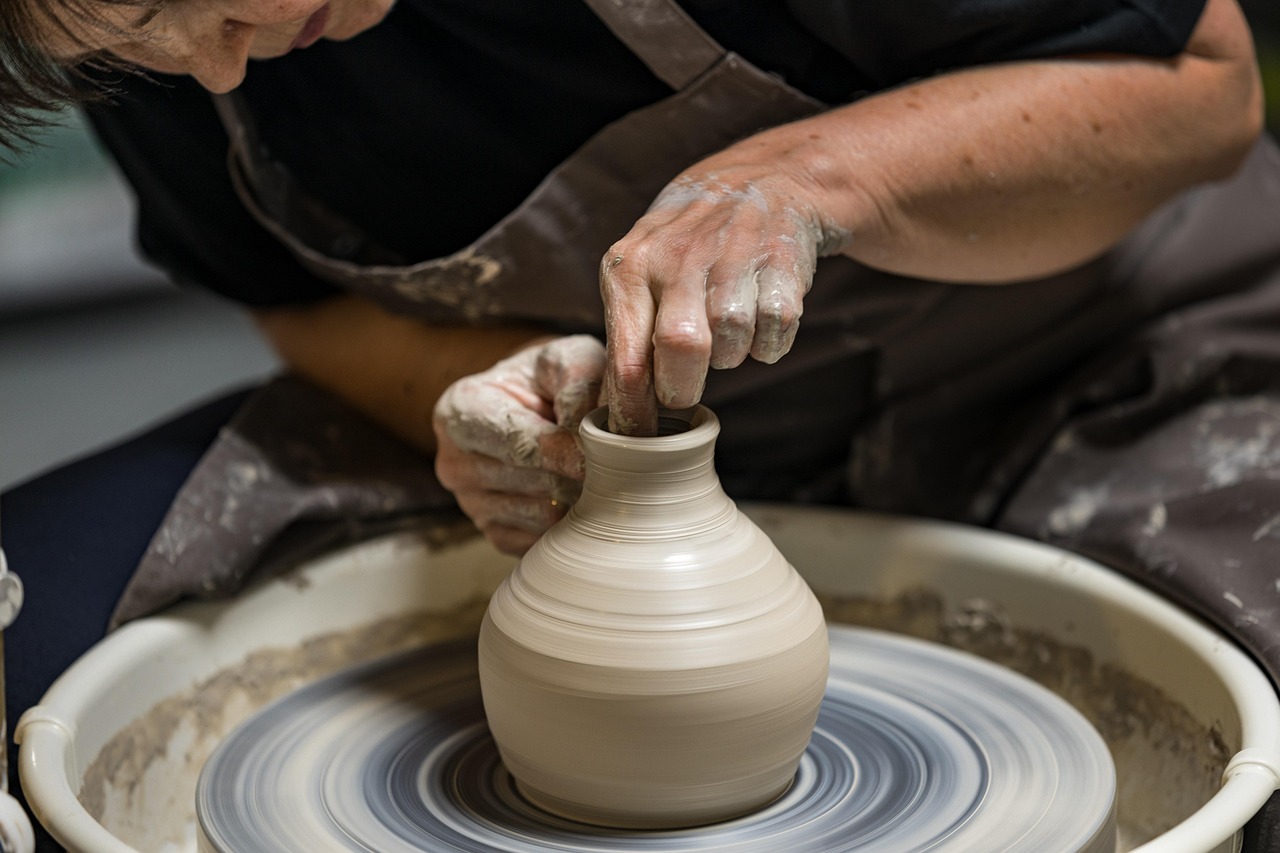
By the 4th millennium BCE, true potter’s wheels and more controlled kilns were established in parts of Mesopotamia and the eastern Mediterranean. The wheel enabled thinner walls, faster production, and greater standardization—useful for urban economies that needed containers for oil, grain, and wine.
Kiln design was as important as shaping methods. Updraft kilns and separated fireboxes let potters raise temperatures and manage oxygen levels, producing more consistent firing. Those controls changed color and strength: oxidizing firings tended to yield reds and buffs in iron-rich clays, while reducing firings could darken bodies and affect glazes.
Glazing marked another leap. Early glazes and glaze-like coatings grew from experiments with silica, alkalis, and lead compounds. In ancient Egypt and the Near East, vitreous materials such as faience (a glazed, quartz-based body) created bright blue-green surfaces, while later lead glazes on earthenware provided a waterproof layer and a glossy finish, improving hygiene and expanding decorative possibilities.
High-Fired Revolutions: Porcelain, Global Trade, and Industry
High-fired ceramics reshaped the global story. In China, stoneware and proto-porcelain developed over centuries as kilns reached higher temperatures (often above 1,200°C), vitrifying bodies and reducing porosity. By the Tang and especially the Song period, refined stonewares and celadons demonstrated how controlled firing and subtle glaze chemistry could produce everything from glassy greens to complex crackle effects.
Porcelain—typically made from kaolin and petuntse or related feldspathic materials—combined whiteness, strength, and translucency. By the time blue-and-white porcelain flourished in the Yuan and Ming eras, it had become both a domestic staple and a major export commodity. Demand spread through maritime and overland routes; shapes and motifs adapted to foreign tastes, while consumers in the Middle East and Europe prized porcelain’s durability and its clean, bright surface compared with many local earthenwares.
Europe’s long pursuit of porcelain culminated in early 18th-century breakthroughs, with hard-paste porcelain produced at Meissen in 1708–1710. Industrialization then accelerated change: coal-fired kilns, standardized molds, transfer printing (popularized in the 18th century), and factory organization made ceramics cheaper and more uniform. At the same time, ceramics expanded beyond tableware—into sanitary ware, electrical insulators, tiles, and later advanced ceramics for aerospace and electronics—showing that the history of ceramics is also a history of materials science.
Conclusion
The history of ceramics tracks human control over heat and minerals: from low-fired earthenware that enabled cooking and storage, to glazed wares that sealed surfaces and carried imagery, to high-fired porcelain and industrial bodies that powered global trade and modern technology.